
How to Increase Social Media Engagement and Captivate Your Audience
Ever felt like you're shouting into the void on social media? You put content out there, but all you hear back is crickets. It's a common frustration, but the good news is that the solution often comes down to one simple shift: stop broadcasting and start a conversation.
And right now, the most powerful conversation starter you have is short-form video.
Your Foundation for Unstoppable Social Media Engagement
If your posts are consistently met with silence, it’s a clear signal that your content just isn't hitting home. Engagement isn't about vanity metrics like likes or follower counts. It's about building a real, active community that genuinely wants to interact with you, share your stuff, and advocate for your brand.
This guide is designed to give you a battle-tested framework for turning those passive scrollers into an enthusiastic audience. We'll dig into what your audience actually wants to see, how to think strategically about each platform, and how you can use AI-powered video tools like Auralume AI to create eye-catching visuals without needing a Hollywood budget.
At its core, genuine engagement comes from a strategy that values human interaction over raw impressions.
The Undeniable Power of Video
Let's be clear: video content isn't just a trend anymore; it's the golden ticket to grabbing attention and driving engagement. There are 5.42 billion people on social media globally—a mind-boggling number. To stand out, you need content that moves.
Consider this: a massive 78% of users say they prefer learning about new products through short videos. And on the business side, 93% of marketers are investing more in their social video strategies. The message is loud and clear: if you’re not making video, you're leaving a huge opportunity on the table. You can find out more about these social media statistics to see the full picture.
This data really underscores the trends shaping social media today, with video sitting right at the center of it all.
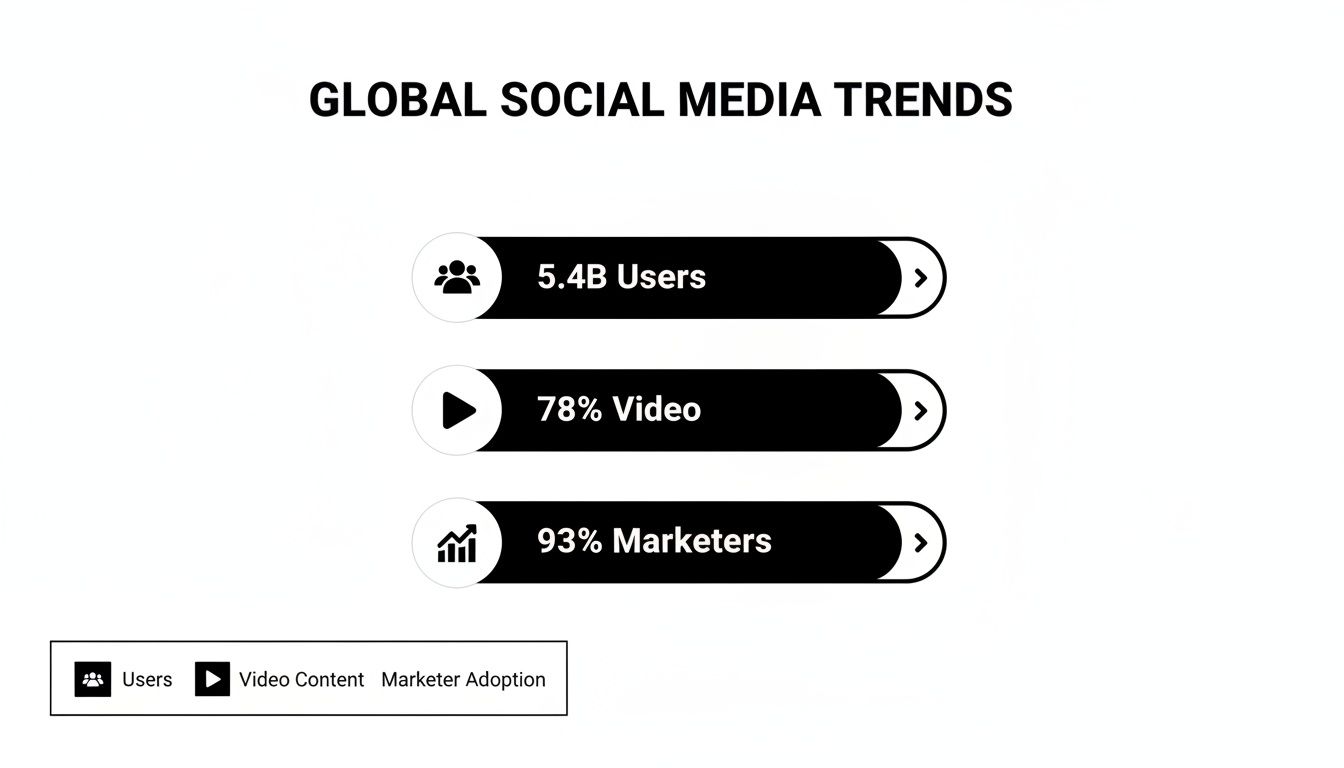
What this chart really drives home is that with such a massive user base and an overwhelming preference for video, marketers have no choice but to prioritize it if they want to stay in the game.
Platform Engagement Snapshot Quick Wins
Not all content works everywhere. Each platform has its own flavor and what kills it on TikTok might flop on LinkedIn. To get the best results, you need to match your content format to the platform's audience and algorithm. This table gives you a quick cheat sheet for where to focus your efforts.
| Platform | Top Performing Format | Average Engagement Rate | Best For |
|---|---|---|---|
| Reels | 1.23% | Brand storytelling, behind-the-scenes, user-generated content (UGC) | |
| TikTok | Short-form videos (15-60s) | 4.25% | Trends, educational "hacks," entertainment, authentic content |
| Video (especially Live) | 0.15% | Community building, news and updates, long-form video, ads | |
| Documents (Carousels), Polls | 2.50% | Industry insights, professional development, company culture, B2B | |
| X (Twitter) | Polls, GIFs, Short Videos | 0.07% | Real-time updates, customer service, joining conversations |
This isn't about being everywhere at once; it's about being effective where you choose to be. Pick one or two formats from this list that align with your brand's goals and start experimenting.
The core principle is simple: Stop selling and start sharing. Authentic, value-driven content—especially video—is the currency of modern social media. It builds trust, fosters community, and naturally drives the interactions you’re looking for. By making your audience feel seen and heard, you create a loyal following that does the marketing for you.
Master Short-Form Video to Dominate Feeds

Let's be real: short-form video isn't just another content format anymore. It's become the native language of social media. Platforms like TikTok and Instagram have completely rewired how people consume content, and now everyone expects quick, dynamic, and authentic videos. If you're serious about boosting engagement, this is non-negotiable.
The numbers don't lie. On TikTok, the average engagement rate per post is a solid 2.5%, but that can shoot up to an incredible 7.5% for accounts with fewer than 100,000 followers. Instagram Reels are still incredibly powerful, too, pulling in about 0.50% engagement on average—that's still three times what you'd typically see on a standard Facebook post. For a deeper dive into these benchmarks, you can explore the latest social media statistics.
What this means for you is simple: getting good at short-form video is your most direct path to grabbing more attention and sparking more conversations.
The Hook-Story-Offer Framework
To create videos that actually get views and comments, you need a solid plan. I've found one of the most reliable structures for short-form video is the Hook-Story-Offer framework. It’s a dead-simple, powerful way to organize your thoughts and deliver a punchy message in under a minute.
-
The Hook (First 1-3 seconds): This is everything. You have a blink-of-an-eye window to stop someone from scrolling. Your hook needs to be visually interesting or emotionally charged. Think of a bold statement flashing on the screen, a surprising camera movement, or a question that makes people instantly curious.
-
The Story (5-50 seconds): Here’s where you deliver the goods. Tell a quick, relatable story. Share a genuinely useful tip. Show a raw, behind-the-scenes look at your process. The goal is to keep it concise and maintain high energy from start to finish.
-
The Offer (Last 3-5 seconds): This is your call to action, but it doesn't have to be salesy. A great "offer" can be as simple as asking a question to get the comments flowing, telling people to save the video for later, or pointing them to the link in your bio for more info.
Using this framework ensures every single second of your video has a purpose, guiding your viewer from curiosity to action.
Practical Tips for High-Performing Videos
You don’t need a Hollywood budget or a professional film crew to make videos that connect with people. It’s all about a few smart techniques and the right tools.
Key Takeaway: The goal of short-form video isn't perfection; it's connection. Authentic, relatable content that provides real value will always outperform an overly polished video that feels like a traditional ad.
Ready to level up your video game? Focus on these three things:
-
Find and Use Trending Audio: The algorithms on TikTok and Instagram are designed to push videos that use popular sounds. Spend a few minutes scrolling the "For You" page or the Reels tab to see what's trending, then get creative about how you can adapt that sound to your brand or niche.
-
Create Seamless Loops: Have you ever watched a video two or three times before you realized it started over? A perfect loop is a clever trick that can dramatically increase your watch time. When the algorithm sees people rewatching your content, it pushes it out to more people.
-
Write Captions That Encourage Interaction: Your caption is prime real estate. Don't just waste it describing what's in the video. Ask a direct question, share a controversial opinion to spark a friendly debate, or prompt viewers to share their own experiences in the comments.
When you combine a simple framework with these practical tips, you can turn your video strategy into a reliable engine for growth. And if you're short on time, AI video tools like Auralume AI can help you generate entire video concepts from a simple text prompt or even animate a static image, making quality video creation accessible to anyone.
Develop a Content Strategy That Sparks Conversation

Great social media has never been about just broadcasting messages—it’s about starting conversations. If your feed feels like a one-way street, it’s time to rethink your entire approach. The goal is to create experiences people want to participate in, not just posts they passively consume.
This means you have to move beyond an endless stream of sales pitches and product announcements. Your content needs to be built on pillars designed from day one for interaction. Think of it like inviting your audience to a party; you need to give them interesting things to talk about and make it easy to jump into the discussion.
Before you can do that, it helps to understand the different types of content on social media that actually work. Getting a handle on this helps you pick the right formats to hit your engagement goals.
Build Your Content Pillars Around Interaction
Your content pillars are simply the core themes you talk about over and over again. The mistake most brands make is building these pillars around their products. Instead, you need to anchor them in topics your audience genuinely cares about. That's how you build a real community, not just a list of followers.
Here are three content pillars that I've seen consistently drive engagement:
-
Behind-the-Scenes (BTS) Stories: Pull back the curtain and show the real people behind your brand. It’s a classic for a reason: people connect with people, not logos. Share a glimpse of your creative process, introduce your team members, or even talk about a mistake you made and what you learned. This kind of vulnerability builds trust and makes your brand feel approachable.
-
User-Generated Content (UGC) Campaigns: Turn your followers into the heroes of your story. UGC is one of the most powerful tools in your kit because it’s instant social proof and makes your community feel seen and valued. Launch a branded hashtag campaign asking people to share photos with your product, or run a contest for the most creative video. When you feature their content, you’re not just getting a free post—you’re building a loyal advocate for life.
-
Actionable Educational Tips: Solve a real, tangible problem for your audience. Don't just list a product feature; show them how to use it to achieve a specific goal. Short, value-packed tutorials, quick hacks, and checklists are incredibly shareable and saveable, both of which are powerful engagement signals that the algorithms love.
Master the Art of the Interactive CTA
A weak call-to-action (CTA) can absolutely kill an otherwise great post. Vague commands like "learn more" or "click the link" are passive and, frankly, boring. A truly effective CTA is a direct, personal invitation to engage.
The key is to ask for a specific, low-effort interaction that feels natural.
Your call-to-action shouldn't feel like a demand; it should feel like the start of a conversation. Prompting questions, debates, and personal stories is far more effective than simply asking for a click or a follow.
Instead of just posting a photo of your new coffee blend, ask a question: "Morning person or night owl? Tell us when you need your coffee fix the most! 👇" This simple tweak turns a static post into an interactive poll and gets the comments flowing.
Use Platform Features to Your Advantage
Don't ignore the amazing interactive tools built right into the platforms you're using. Instagram Stories, for instance, are a goldmine for daily, lightweight interactions that keep your brand top-of-mind without a huge effort.
Make these part of your regular routine:
- Polls: Settle a fun debate or gather quick feedback on a new idea.
- Quizzes: Test your audience's knowledge about your industry or products.
- Q&A Stickers: Invite followers to ask you anything, then share the best questions and your answers.
These features only require a single tap from a user, making participation almost frictionless. By using them consistently, you're actually training your audience to interact with your content, building a habit of engagement that will spill over to the rest of your feed.
Engage Your Community Like a Human, Not a Bot
Hitting “publish” isn’t the finish line. Honestly, it’s just the starting gun. The real work begins the moment your content goes live, and the most successful brands out there know this. They treat their social media feeds like a bustling community, not just a digital billboard.
How you show up in the comments and DMs is where the magic really happens. This is your chance to turn casual scrollers into loyal fans.
Think about it from your own experience. When you take the time to write a thoughtful comment on a post, getting a generic "Thanks!" or a lone emoji back feels pretty deflating, right? It almost feels like a bot is running the show. The goal is to reply like an actual person would—use their name, mention something specific they said, and maybe even ask a question to keep the conversation going.
This is the heart of good community management. Every single reply is a chance to show off your brand's personality and make someone feel genuinely seen and heard.
Master Your Brand Voice in Every Reply
To build a brand people remember, you need to be consistent. Before you can jump into the comments, you have to nail down what your brand actually "sounds" like. Are you the witty, playful friend? Or are you more of an encouraging, helpful guide?
Once you've defined that voice, use it everywhere. That consistency is what builds trust and makes your interactions feel genuine instead of like you're reading from a script.
Here’s how that looks in practice:
- Witty Brand Example: A user comments, "I need this coffee in my life." Instead of a bland "Glad you like it," you could say, "Warning: may cause extreme productivity and an inability to stop smiling. 😉"
- Educational Brand Example: Someone comments, "This video editing tip is amazing!" A great response would be, "So glad it helped! Have you tried pairing it with the color grading trick we shared last week? They work great together."
See the difference? This kind of personalized engagement proves you’re paying attention and actually adds value.
The goal isn't just to respond; it's to deepen the connection. A thoughtful reply can turn a simple comment into a memorable, positive experience for a follower, making them far more likely to engage again in the future.
Handling Feedback and Proactive Engagement
Let's be real—not every comment is going to be a glowing review. And that’s perfectly fine. How you handle negative feedback is a massive opportunity to show your authenticity and commitment to your customers.
Always acknowledge their frustration, thank them for bringing it to your attention, and offer to take the conversation to a DM to sort it out. Handling criticism gracefully and publicly builds an incredible amount of trust with everyone watching.
But don't just stay on your own page. To really grow, you need to engage proactively. I recommend setting aside a little time each day to interact with others in your industry. Comment on their posts, share their work when it makes sense, and join conversations happening under relevant hashtags. This positions you as an active community member, not just a brand pushing a product. For more on this, check out these strategies to increase social media engagement and build community.
Finally, always be on the lookout for those "surprise and delight" moments. Did someone leave an incredibly kind or detailed comment? Screenshot it, share it to your Stories, and tag them. It’s a small gesture, but that kind of recognition can create a brand advocate for life.
Measure, Analyze, and Optimize for Continuous Growth
 Creating and posting great content is really just the beginning. If you’re not digging into the data to see what’s working, you’re just guessing and hoping something lands. To see real, sustainable growth, you need to turn your social media efforts into a feedback loop—where every post is a lesson that sharpens your strategy.
This all starts with looking past the vanity metrics. Sure, likes and a rising follower count feel good, but they don't tell the whole story. What you really want are the numbers that signal genuine interest and prove your content is valuable enough to inspire action.
Focus on Metrics That Matter
To really get a handle on your performance, you have to track the right data points. These are the metrics that show people aren't just scrolling by; they're actually stopping and engaging in a meaningful way.
- Shares: Think of this as modern word-of-mouth. When someone shares your post, they're not just consuming it—they're endorsing it. This is a massive signal to the algorithm that your content is worth showing to more people.
- Saves: A save is a huge compliment. It means your content is so useful or interesting that someone wants to come back to it later. It's a key indicator of value, especially for tutorials, tips, or inspiration.
- Comment Rate: This is all about conversation. It shows what percentage of your audience was moved enough to actually type out a response. This metric is your direct line to understanding what topics spark debate, curiosity, or emotion.
- Profile Visits: This number tells you that your content was so compelling it made someone stop and think, "I wonder what else they've got." It's often the step right before a follow or a click-through to your website.
When you zero in on these deeper engagement signals, you get a much clearer picture of what your audience truly wants from you.
Tracking the right metrics is crucial, but knowing what they mean and what to do with that information is where the real power lies. Let's break down some of the most important ones.
Key Engagement Metrics to Track
| Metric | What It Measures | Why It Matters | How to Improve It |
|---|---|---|---|
| Shares | How many users shared your post to their own feed, stories, or DMs. | It’s the ultimate endorsement. Shares expand your reach organically to new, highly-relevant audiences. | Create highly relatable memes, controversial (but on-brand) opinions, or incredibly useful infographics that people will want to pass along. |
| Saves | The number of times users saved your post to a collection. | Indicates high-value, evergreen content. It tells algorithms your content is a resource people want to revisit. | Post educational carousels, detailed tutorials, checklists, or inspiring quotes. Anything someone might want to reference later is a good candidate. |
| Comment Rate | The percentage of your audience that comments on a post. | Measures how much conversation your content is generating. It shows you're building a community, not just broadcasting. | Ask open-ended questions in your captions, run polls, and reply to every comment you receive to encourage more interaction. |
| Click-Through Rate (CTR) | The percentage of users who clicked a link in your post or bio. | Measures how effective your content is at driving action off the platform. This is critical for lead generation and sales. | Use clear, compelling CTAs. Ensure the link is relevant to the post and offer something valuable on the other side (e.g., a free guide). |
Focusing on these numbers gives you an actionable scorecard. You can stop chasing likes and start building a strategy that drives tangible results.
Conduct a Simple Content Audit
Now that you know what to look for, it's time to review what you've already done. A content audit sounds intimidating, but it doesn't have to be.
Just open a simple spreadsheet and pull the data for your last 15-20 posts. Track the key metrics we just discussed for each piece of content.
Pretty soon, patterns will start to jump out at you. Maybe you'll find that your behind-the-scenes Reels get twice as many saves as polished product shots. Or perhaps you'll see that posts with a direct question get 50% more comments. This is your roadmap for what to do next.
Your past content is a goldmine of data. An audit isn't about judging your past efforts; it's about uncovering the hidden gems that show you exactly what to create next to drive better results.
A/B Test for Systematic Improvement
Once you have these insights, you can stop guessing and start testing. A/B testing is simply comparing two slightly different versions of a post to see which one performs better. It’s a methodical way to figure out what truly moves the needle.
Here are a few easy A/B tests you can run:
- Video Hooks: Post the same video twice (on different days), but change only the first three seconds. Test a bold text hook against a surprising visual or a question.
- Captions: Use the same image or video but write two completely different captions. Does a short, punchy caption outperform a longer, more detailed story?
- Posting Times: Take two similar pieces of content and post them at different times suggested by your platform's analytics. This helps you find your audience's true sweet spot for engagement.
By consistently measuring, analyzing, and testing, you create a powerful cycle of improvement. Every post becomes a small experiment, making your strategy smarter and more effective over time.
Your Top Social Media Engagement Questions, Answered
Even the best-laid plans come with questions. As you start digging into these strategies, you're bound to wonder about a few things. That’s perfectly normal. Think of this as a quick chat where we tackle some of the most common hurdles people face.
Let's clear up a few of those lingering questions you probably have.
How Often Should I Post to Maximize Engagement?
This is the million-dollar question, isn't it? The truth is, consistency will always beat frequency. I’ve seen so many brands burn out trying to post three times a day, and the quality of their content tanks. Don't fall into that trap.
Instead, find a rhythm you can actually stick with. For most businesses, posting a solid 3-5 times per week on your main channels is a great place to start. This keeps you relevant and in front of your audience without flooding their feeds or stretching your creative team too thin.
The golden rule? Always, always prioritize quality over quantity.
Should I Buy Followers to Look More Popular?
Let me be blunt: absolutely not. Buying followers is one of the worst things you can do for your account, and it will actively sabotage your engagement. Those purchased accounts are just bots or ghost followers—they will never like, comment, or share your posts.
This creates a domino effect of bad news:
- Your engagement rate plummets because you have thousands of followers who do nothing.
- The platform's algorithm sees this low engagement and assumes your content isn't interesting.
The algorithm then stops showing your posts to the people who actually want to see them: your real, loyal followers. Spend your time building a genuine community, not inflating a vanity metric.
My Two Cents: A small, fired-up audience of 1,000 true fans is a thousand times more valuable than an audience of 100,000 silent bots. Real interaction is the only thing that builds a brand people actually care about.
What’s the Best Time of Day to Post?
You can find hundreds of infographics online claiming the "best time to post" is Tuesday at 11 AM. Ignore them. The only time that matters is when your specific audience is online and scrolling.
So, how do you find that magic window? Dive into your native analytics. Tools like Instagram Insights or TikTok Analytics are your best friends here. They will literally show you the exact days and hours your followers are most active on the platform.
Once you have that data, experiment by posting right before or during those peak hours. This gives your content the best shot at getting seen the moment your followers open the app. Test a few different times and see what gets the best initial buzz.
Ready to create stunning, scroll-stopping videos that drive real interaction? With Auralume AI, you can turn a simple idea or image into a cinematic masterpiece in seconds. Stop guessing and start creating content that captivates your audience. Try Auralume AI today and see the difference it makes.